
Signals: Digital and Analog#
Binary represents a Digital Signal#
Modern computer science depends on electricity to physicially store and transfer information. In this program, you have learned about the binary representation of information, which depends upon the electrical transistor to store the “values” 0 and 1.
The binary representation of information using electricity is a canonical example of a digital signal: that is, a digital signal is any means of communicating information that only distinguishes between high (1) and low (0) voltage.
What other ways can information be transmitted using electriciy? In this class, we will use low-power hardware that does not have complex operating system or CPU capabilities to represent information for us – we will become familiar with “lower level” protocols for transmitting information electrically.
We will begin by understanding the difference between digital and analog signals.
Analog: the natural world#
We live in an analog world. Most of the naturally occurring events that we experience happen in an analog form.
Analog signals varies continuously in time and amplitude.
This means that changes happen over a range of values with infinite “in between” steps.
For example, the following events have an infinite number of transitions. It only depends on how accurately you can track them:
The colors in a rainbow.
The position of a swinging pendulum.
The exact time of the day.
Voltage#
One of the primary methods for measuring any analog signal with electronics is to convert the physical phenomena to a voltage – that is, an electric potential that can easily be measured and converted to a digital value.
An example is a joystick: a joystick controls the position of a potentiometer, which increases or decreases the voltage drop across a resistor between high (Vcc) and low (GND).
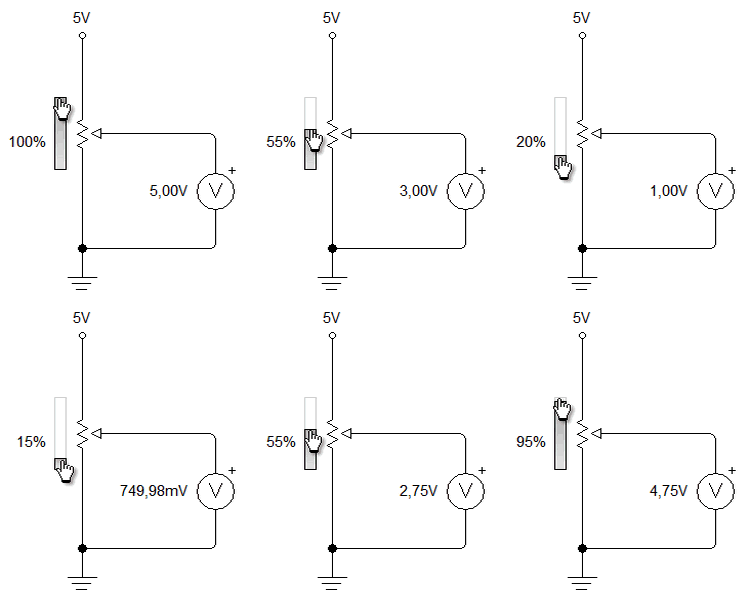
Potentiometer position increasing and decreasing voltage. Under the hood, a joystick is a device that controls two potentiometers, one for each of the X and Y directions. (Image source: Panama Hightek)#
With a potentiometer, we can actually convert most physical phenomena to a range of voltages – see the examples below.
Temperature#
The A/C and heating systems in a house are typically activated once the temperature reaches some minimum and maximum values.
The chart below is tracking the temperature in a room as the A/C and heating systems are activated over a few days.
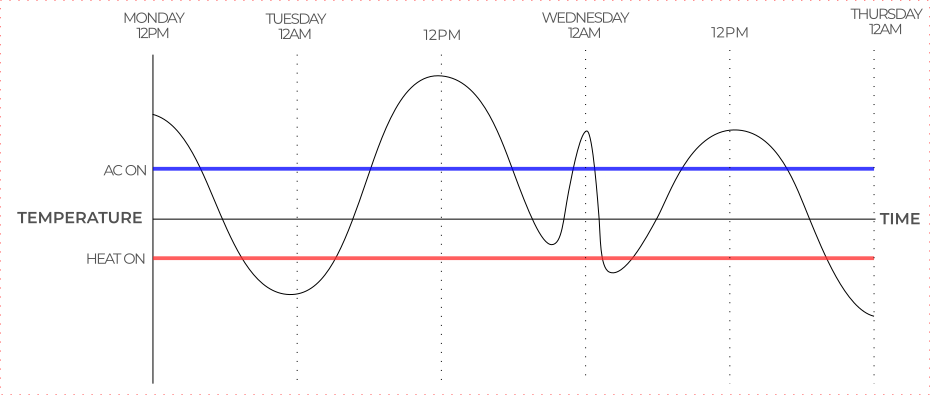
Temperature changes over time Adapted from poster: Analog and Digital Signals by Digikey.
Let’s say the maximum temperature reached in the room is 30C and the minimum temperature is 15C. A person in the room would have observed every possible temperature in between that range (15.01, 15.0101, 15.0102, 15.01021, etc).
The change in temperature produces analog information since it is changing over an infinite range of values.
Sound#
Sound is also an example of an analog signal.
When a volume of air is displaced quickly, air molecules are compressed against each other creating a high-pressure region. The high pressure region expands and compresses the air in the neighbouring area. Sound can travel thanks to this “chain effect”.
By observing how the air pressure changes over time, we can draw a sound wave.
This is how speakers and microphones interact with air to generate sound.
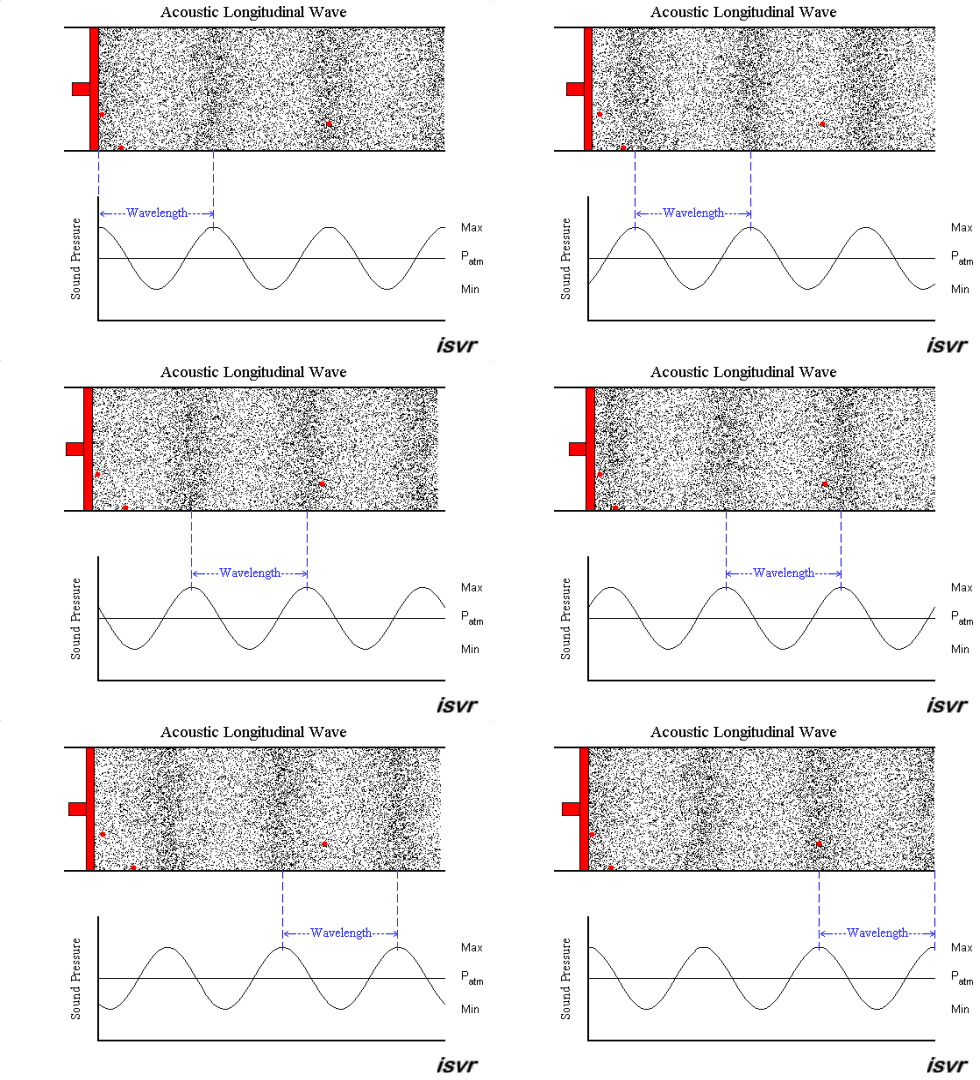
Sound waves travelling through air - Waves and Acoustics Animations by isvr.
Sound waves are also an example of an analog signal because the amplitude of the wave transitions through the entire range of possible values between the Min and Max.
Analog Signals Graphs#
A signal varies over time. It’s helpful to plot it on a graph where time is plotted on the horizontal, x-axis, and the value being tracked on the vertical, y-axis.
Looking at a graph of a signal is usually the easiest way to identify if it’s analog or digital.
When dealing with electricity we track voltage levels (amplitude).
A time-versus-voltage graph of an analog signal should be smooth and continuous.
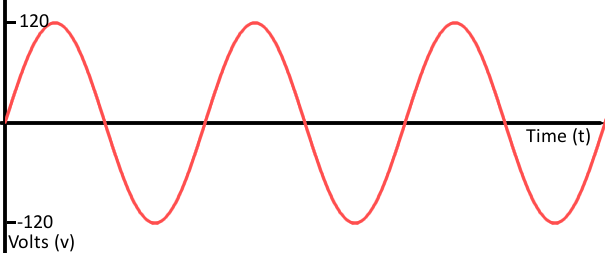
While these signals may be limited to a range of maximum and minimum values, there are still an infinite number of possible values within that range.
For example, the analog voltage coming out of your wall socket oscillates between -120V and +120V. As you increase the resolution more and more, you discover an infinite number of values that the signal can actually be (64.4V, 64.42V, 64.424V, and other increasingly precise values).
Digital: discrete values#
Digital signals are discrete, which means that the only distinction is between off and on: a high voltage and a low voltage, like a binary number.
Note
The specific values of the high and low voltages depend on the power source – a circuit powered by 3.3V will have a 3.3V high, while a circuit powered by a 5V source will have a 5V high. Ground is always zero volts (like ground in real life, is always 0 meters – a relatve measure).
Below is a the timing graph of a signal whose low voltage is 0 volts and high voltage is 5 volts.
This type of signal is also known as a square waves.
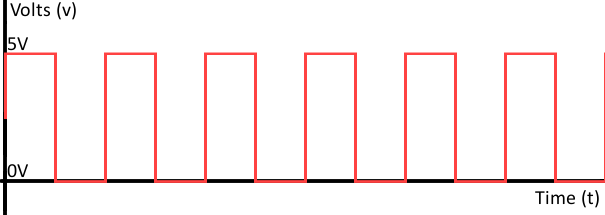
0 to 5 volt “pulses” forming a square wave. Analog vs. Digital by Digikey#
Digital Simulating Analogue#
A digital signal might be a discrete representation of an analog waveform.
Viewed from afar, the wave function below may seem smooth and analog, but when you look closely there are tiny discrete steps as the signal tries to approximate analog values.
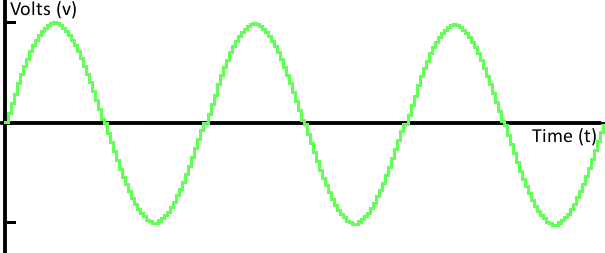
Oscillating voltage from -120V to 120V approximated by overlapping digital signals. Analog vs. Digital by Digikey#
The number of discrete steps that a digital signal can use depends on how many bits are available for each recorded value. This is also called bit resolution (see Sampling below).
For example, if a data point can only use one bit of definition, then it can only track on/off states, resulting in the red square wave seen above.
However, if a data point can use 8 bits to store a value, then it can represent a value ranging from 0 to 255 (see the green sinusoidal voltage wave above).
Analog to Digital Conversion (ADC)#
If most natural events are analog, how do we represent them in digital format? For example, if audio is analog, how can we get a computer to play music?
An analog to digital converter (ADC) is a device that can read a analog signal and generate a digital representation of this signal.
ADC’s are specific to the type of analog signal they are trying to read (sound, voltage, temperature, light, etc).
Referring to the room temperature example used earlier, if we used a digital thermometer to record the temperature, our graph might look like the following:
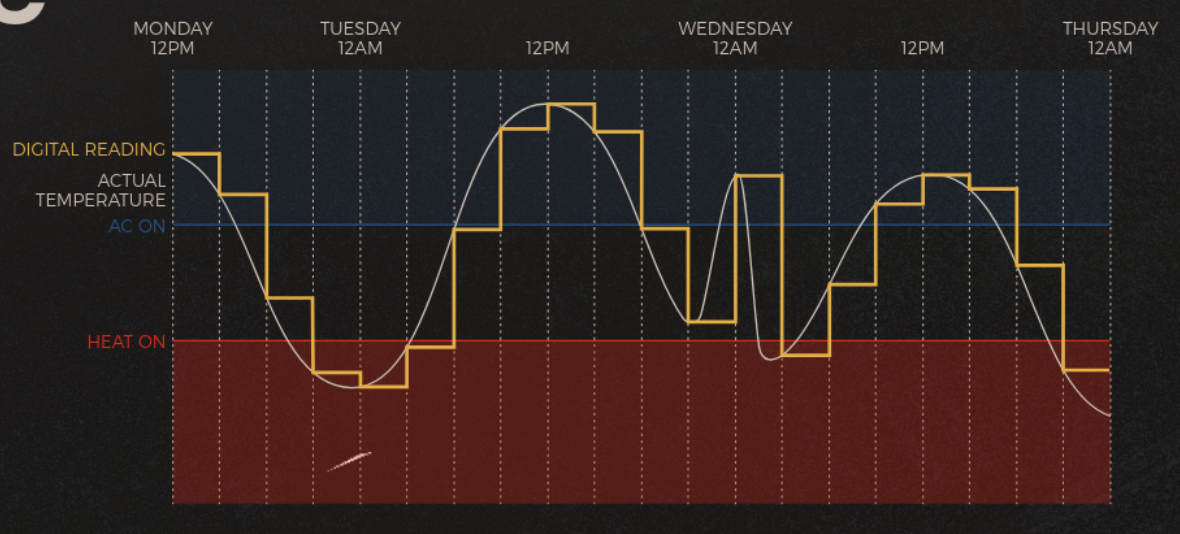
Temperature represented as a digital reading Poster: Analog and Digital Signals by Digikey.
In the example above, a digital temperature reading was taken every 3hr.
The digital signal representation of the temperature is not smooth or accurate.
However, depending on the application it might be sufficient.
To make the signal smoother or more representative of the real analog signal we need to take samples more regularly (eg. every 1min).
The process of reading an analog signal over time to generate its digital representation is called sampling.
Sampling#
Sampling is the process of inspecting the value of an analog signal at regular time intervals.
When an ADC is sampling an analog signal, there are two variables that will characterize the digital output:
Sampling rate.
Bit resolution.
Music sampling Some music genres like rap and hip-hop commonly sample song segments from other artists to play in the background.
The term sampling is used because traditionally song segments were extracted from vinyl records which produce analog sound and saved in digital formats.
Sampling rate#
The time between samples is the sample period (T, in seconds), and the number of samples taken per second is the sample frequency or sample rate (fs, in samples/second or Hz).
Basically, sampling is taking snap-shot values of the analog signal at regular time intervals.
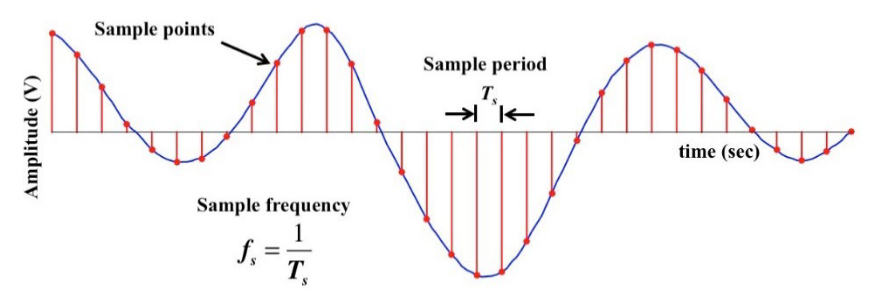
Sample period and fequency for an electric signal - US Naval Academy.
Sampling period examples:
If a signal is sampled every half second (0.5s sampling period, T), the sample frequency (*f**) is 1/0.5s = 2 Hz (times per second).
If the sample frequency (f) is 2000 Hz, the sampling period (T) is = 1/2000Hz = 0.0005 secs (0.5 milliseconds).
The higher the sample rate, the more accurate the digital signal is.
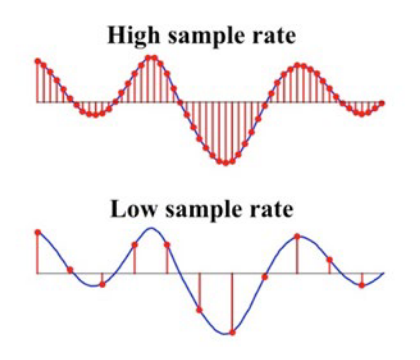
Same signal sampled with different sample rates - US Naval Academy.
Encoding#
Encoding is the process of mapping the sampled analog signal value to discrete binary numbers (digital information).
ADC devices are characterized by the number of bits available to represent a signal.
For example, consider an electrical signal that ranges from -1 volts to to +1 volts and must be converted to a 3 bit number.
To approximate the numeric conversion from a voltage signal to a digital output, follow the steps below:
Identify the minimum and maximum voltage values that can be observed in the input.
Example: -1 to +1 volts (2 volt range)
Identify the minimum and maximum binary values that can generated as the output. Note the amount of unique numbers represented by this range
Example: For a 3-bit number: 000 (decimal 0) is the minimum and 111 (decimal 7) is the maximum, making a total of 8 unique numbers.
Divide the voltage range that will be observed (max voltage - min voltage) by the amount of unique binary numbers available. This will determine the voltage increment that each binary number represents.
Example: (+1V - (-1V)) / 8 = 2V/8 = 0.25V
Layout each binary number and their increments and read where the voltage values lie.
Assuming the ADC has a resolution of 3 bits, all voltage values (-1V to 1V) must be represented with at most 3 bits, or 2^3 = 8 unique values (0 is a unique value).
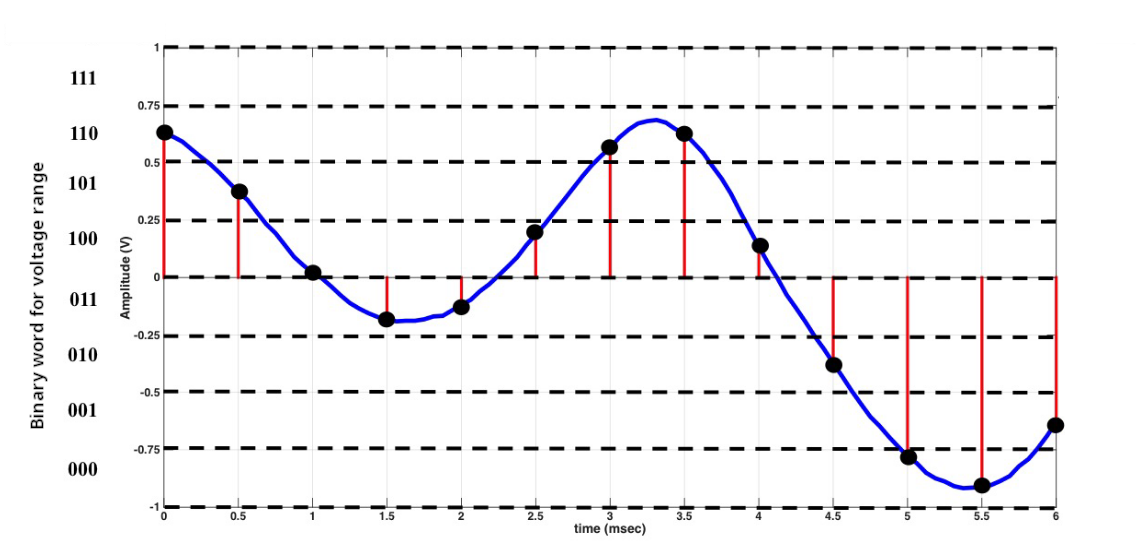
Voltage signal between -1V and 1V converted to digital with a 3 bit resolution - US Naval Academy.
In this case:
000 is assigned to the voltages from -0.75 V to -1.0 V,
001 is assigned to the voltages from -0.5 V to -0.749 V,
010 is assigned to the voltages from -0.25 V to -0.49 V,
and so on.
The binary representation of the above signal is:
110 101 100 011 011 100 110 110 100 010 000 000 001
If the sampling is happening 2000 times per second (Hz) and for every sample we generate 3 bits, we are generating 2000 x 3 bits = 6000 bits/sec of information. This is also know as the bitrate.
If a song of 3 minutes is sampled with the same specs, how big will this file be in kB?
What is the bitrate of music on Spotify?
Sensor voltages & bit resolution#
IoT systems typically work with electrical signals encoded in voltage levels.
Every hardware that converts from analog to digital (and vice-versa) needs to have an appropriate ACD device.
Microcontrollers are often used to process these signals because they often have an integrated ACD and they are very inexpensive.